
Data Center Setup UAE: On-Premises vs Colocation Guide
Table of Content
- Why the Data Center Decision Is an Operating-Model Decision
- What Is an On-Premises Data Center?
- What Is Colocation?
- Why UAE Businesses Compare Both Models
- Consider the Total Cost‚ Not Just Monthly Payments
- Resilience‚ Uptime‚ And Disaster Recovery
- Security‚ Compliance‚ and Data Governance
- Connectivity and Cloud Integration
- Migration from the Server Room to Colocation
- Questions to Ask a Colocation Provider
- Data Center Setup Checklist
- How Americana Computers Can Help
- Conclusion
- Frequently Asked Questions
An on-premises data center is directly owned and operated by the organization‚ which has direct control over facilities‚ hardware‚ security and operations․ In colocation‚ the business infrastructure is hosted inside a third-party operator's data center‚ while the provider supplies space‚ power‚ cooling‚ network connectivity and physical security․ UAE organizations consider workload criticality‚ capital budget‚ personnel‚ scalability‚ latency‚ compliance and recovery objectives when deploying workloads‚ often using hybrid deployment strategies․
Key Takeaways
- On-premises data centers provide direct control but require the organization to manage facilities, hardware and operations.
- Colocation places customer-owned equipment in a provider facility that supplies space, power, cooling and physical security.
- Choose the model according to workload criticality, latency, resilience, internal skills, compliance and future growth.
- Compare five-year total cost rather than only the initial build cost or monthly colocation fee.
- Define RTO and RPO before selecting backup, replication and disaster-recovery technologies.
- Colocation does not transfer responsibility for operating systems, applications, accounts, data, patching or backups.
- Test connectivity, application performance and recovery procedures before completing a colocation migration.
- Use a hybrid model when different workloads have different latency, control, scalability or recovery requirements.
- Review provider power, cooling, security, carrier options, remote hands, SLAs and exit conditions before signing.
Why the Data Center Decision Is an Operating-Model Decision
Data center planning determines rack prices‚ colocation pricing‚ as well as uptime‚ security‚ scalability‚ disaster recovery‚ staffing‚ connectivity‚ and infrastructure ownership of a particular data center facility․
Weak decisions may result in reduced power/cooling/access control ability‚ downtime‚ or unmanaged backups‚ along with an expensive migration later․ The appropriate model for the specific workload depends on how critical it is‚ and indeed whether the skills exist to run it effectively on a particular model․
What Is an On-Premises Data Center?
An on-premises data center is infrastructure that resides in a building owned and operated by the organization‚ such as a server room or private data center․
The business owns racks‚ uninterruptible power supplies‚ cooling‚ fire protection‚ physical security monitoring, connectivity‚ maintenance, and lifecycle replacement‚ so that gives greater control but means much more operational involvement․
What Is Colocation?
Colocation is the practice of placing customer-owned servers‚ storage, and network equipment in a third-party data center․ The provider supplies power‚ space‚ cooling‚ networking‚ physical security‚ and other day-to-day facility operations․ In a public cloud‚ many of these parameters are handled by the public cloud provider; in colocation‚ the customer generally owns the hardware‚ operating system‚ applications‚ data‚ and configuration without managed services․
Why UAE Businesses Compare Both Models
UAE organizations typically consider UAE on-premises data centers and colocation when relocating offices‚ refreshing infrastructure‚ planning disaster recovery‚ rapidly scaling operations‚ or lacking space in their server rooms․ Potential causes include limited cooling and power protection‚ limited carrier options‚ lack of internal resource‚ business continuity requirements and lack of resilient infrastructure in Dubai‚ Abu Dhabi and across multi-site operations․
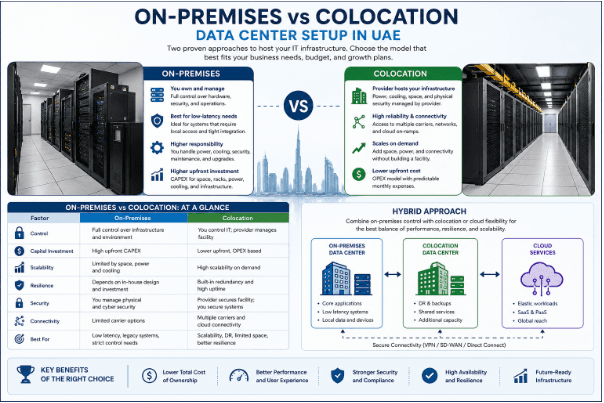
Choose On-Premises When․․․
Use on-premises when workloads need very low local latency‚ control of local physical hardware‚ or tight integration with on-premises plant‚ medical‚ production‚ laboratory‚ and security systems․
It is best if the organization hosting the model has an appropriate facility‚ reliable power and cooling‚ physical security‚ knowledgeable staff‚ monitoring‚ and a defined lifecycle for the resources․
Choose Colocation When․․․
Choose colocation if the existing data center lacks resilient power‚ cooling‚ fire protection‚ carrier diversity and physical security․ The business may also need this increase in capacity without building a new facility‚ for geographic separation for disaster recovery‚ to connect with multiple carriers or for greater resiliency while controlling their own facility․
Use a Hybrid Model When․․․
A hybrid model may be effective when some systems are amenable to remaining on-premise‚ while others can be deployed in colocation or cloud․ For example‚ latency-sensitive applications can remain on-premises and central applications‚ backups‚ disaster recovery‚ shared services and elastic compute can be moved to colocation․ A hybrid model is more complicated‚ so identity‚ networking‚ monitoring‚ backup‚ security and support should be documented․
Consider the Total Cost‚ Not Just Monthly Payments
The cheaper model is the one that provides the required resilience and growth at the lowest risk-adjusted total cost‚ rather than simply the lowest price in the first year․ In-house expenses include space‚ fit-out‚ racks‚ UPS‚ cooling‚ fire suppression‚ building security‚ networking circuits‚ labor‚ warranties‚ monitoring‚ refresh and replacement cycles․ Colocation expenses include space‚ power‚ cross-connects‚ internet connectivity‚ remote hands‚ migration‚ support‚ expansion‚ and exit fees․ A five-year cost model is of more use than a simple monthly comparison․
💡 Pro Tips
Build a five-year cost model covering facilities, power, cooling, connectivity, staffing, hardware refresh, migration, remote hands, expansion and exit costs before comparing on-premises and colocation options.
Resilience‚ Uptime‚ And Disaster Recovery
Resilience planning factors include redundancy of power‚ cooling‚ carrier diversity‚ fire‚ physical access‚ environmental monitoring‚ spare capacity‚ and escalation․ RTO and RPO should guide designing and implementing the solution․ Restores from backups have not been proven to be sufficient for recovery and should be practiced in disaster recovery exercises․
Security‚ Compliance‚ and Data Governance
Security responsibility does not disappear with colocation․ The facility is maintained and secured by the provider‚ but the customer manages systems‚ accounts‚ applications‚ data‚ patching‚ backups‚ access management‚ encryption‚ and monitoring‚ unless otherwise specified in a managed service contract․UAE PDPL and industry-specific obligations should be reviewed with legal and compliance advisers before finalizing the model․
Connectivity and Cloud Integration
Colocation can improve access to carriers‚ cross-connects‚ private circuits‚ clouds VPN and SD-WAN‚ and links to branches‚ but this can be facility-dependent․ Test latencies and performance of critical applications before migration․ Design connectivity for redundancy‚ observability‚ public IPs‚ routing‚ firewalling and escalation paths․
Migration from the Server Room to Colocation
Start a colocation migration with an inventory and dependency mapping․ Document the servers‚ storage‚ firewalls‚ applications‚ licenses‚ warranties‚ backups‚ the network paths between the components‚ support contracts and the users․ Design the target rack‚ power‚ cabling‚ addressing‚ firewall rules‚ monitoring‚ access‚ maintenance window‚ fallback path and test scripts․ The source environment cannot be destroyed until applications‚ backups‚ monitoring‚ security controls‚ and performance are validated․
Questions to Ask a Colocation Provider
Ask what rack space/power/cooling/fire protection/physical security/access process/carrier options/cross-connects/remote hands/monitoring/SLAs/service credits/expansion/exit conditions/audit evidence are provided‚ how they are delivered‚ and if there are fees associated with them․ It also states how emergency access‚ deliveries‚ maintenance windows‚ outages caused by the provider‚ and customer equipment replacements are handled․
Data Center Setup Checklist
Ensure that all workloads‚ their importance‚ capacity‚ latency‚ power consumption‚ cooling requirements‚ rack space‚ connectivity‚ RTO‚ RPO‚ backup frequency‚ disaster recovery strategy‚ security‚ migration approach‚ rollback plan‚ testing plan‚ documentation‚ and support ownership have been noted․ Facility cost should not be the only project driver․
How Americana Computers Can Help
Americana Computers enables UAE enterprises to assess‚ design‚ implement‚ migrate and support on-site‚ colocation and hybrid data center infrastructure across servers‚ storage‚ networking‚ security‚ backup and disaster recovery․ Americana Computer Systems works as a systems integrator and infrastructure partner in the UAE‚ providing data center design‚ server and storage deployment‚ hybrid cloud integration‚ backup and disaster recovery‚ structured cabling‚ cybersecurity‚ migration planning‚ and IT operations support․ According to Americana Computers‚ the right model of data center is not determined by who owns the hardware but is based on workload criticality‚ resilience targets‚ operational capability and total cost․
Conclusion
On-premises data centers maximize control‚ colocation alleviates facilities concerns‚ and colocation can improve resilience‚ carrier diversity‚ and disaster recovery options․ Hybrid infrastructure resources are employed where different workloads have different needs․ Companies in the UAE should assess their workloads‚ resilience‚ security‚ staffing‚ scalability‚ connectivity and total cost of ownership before building on-premises or signing a colocation lease․
Frequently Asked Questions
1. What is the difference between an on-premises data center and colocation?
On-premises infrastructure is hosted in a business-controlled facility, while colocation places customer-owned equipment in a specialist provider facility.
2. Is colocation cheaper than building an on-premises data center?
It depends on facility costs, power, cooling, staffing, migration, support, expansion, and long-term resilience needs.
3. When should a UAE business use colocation?
Use colocation when the business needs better facility resilience, carrier access, scalability, or disaster recovery without building its own data center.
4. Does colocation mean moving to the cloud?
No, colocation usually means hosting customer-owned hardware in a third-party data center facility.
5. Who owns the servers in a colocation data center?
The customer usually owns or controls the servers unless managed hardware is included in the contract.
6. What should be included in a data center setup checklist?
It should include workloads, capacity, power, cooling, connectivity, security, backup, DR, migration, documentation, and support.
7. How do I compare colocation providers in the UAE?
Compare power, cooling, redundancy, connectivity, security, access procedures, SLAs, remote hands, expansion, and exit terms.
8. Can an organization use on-premises and colocation together?
Yes, many businesses use a hybrid model for latency-sensitive systems, central workloads, backup, and disaster recovery.
9. How does colocation support disaster recovery?
It can provide geographic separation, resilient facilities, connectivity options, and a secondary site for backup or recovery systems.
10. What security responsibilities remain with the customer in colocation?
The customer remains responsible for operating systems, applications, accounts, data, backups, patching, and configurations unless separately managed.

Tehreem Fazal is a creative strategist, content marketer, and freelance writer with over six years of experience crafting impactful stories for local and international brands. She specializes in content strategy, brand storytelling, and SEO-driven writing across industries like fashion, real estate, food, digital marketing, lifestyle, and automotive etc. Her words have shaped the voice of leading names including Master Group, LUMS, Metropolitan Properties UAE, and more. With a background in English Literature, Tehreem blends creativity with strategy to make every piece of content resonate and convert. When she's not writing, she's exploring new ideas, brands, and narratives that inspire.

Immutable Backup for UAE Businesses: Ransomware-Proof Data Protection
Learn how immutable backup protects UAE businesses from ransomware, including WORM storage, 3-2-1-1-0, cloud backup, Veeam, costs, and recovery testing.
Read MorePCI DSS Compliance in the UAE: What Merchants and Enterprises Must Know
A plain-language guide to PCI DSS compliance in the UAE — the 12 requirements, merchant levels, scope reduction, and the IT controls retailers and hotels need.
Read More