
Cloud Migration for SMEs in UAE | Timeline, Risks & Costs
Table of Content
- Why SMEs Need a Migration Strategy‚ Not Merely a Cloud Subscription
- Cloud Migration Planning Snapshot
- What Is Cloud Migration?
- Which Workloads Should SMEs Move First?
- Cloud Migration Timeline for SMEs
- What Drives Cloud Migration Costs?
- Cloud Migration Risks and Challenges
- A Practical Cloud Migration Roadmap
- SME Cloud Migration Readiness Scorecard
- UAE Security and Governance Considerations
- How to Minimize Downtime
- Common Cloud Migration Mistakes
- Should You Use a Cloud Migration Partner?
- Conclusion
- Frequently Asked Questions
Enterprise cloud migration for SMEs typically begins with workload discovery‚ dependency mapping‚ security‚ backup‚ a phased cloud migration plan‚ and an understanding of one-time and operational costs․ Email and collaboration apps are relatively easy to migrate‚ but for complex applications‚ testers may need to specify rollback steps to avoid interruptions and then tune the application after migration․
Key Takeaways
- Begin with workload discovery, dependency mapping and business-priority assessment.
- Move low-risk, cloud-ready workloads before complex business-critical applications.
- Use phased migration waves instead of moving every system at once.
- Separate one-time migration expenses from recurring cloud operating costs.
- Configure identity, MFA, backups, logging and access controls before migration.
- Test a representative pilot workload before starting production migration waves.
- Include validation, user acceptance testing and rollback in every cutover plan.
- Review cloud-region, contractual, security and data-governance requirements.
- Optimize performance and cost only after migrated workloads have stabilized.
Why SMEs Need a Migration Strategy‚ Not Merely a Cloud Subscription
With remote working, hybrid work, digital collaboration, cyber resilience and business growth top of mind, cloud adoption has become increasingly important for small and medium-sized enterprises in the UAE.
Without a cloud migration strategy‚ unexpected downtime‚ overspending‚ security risks and low user adoption are common pitfalls․ Creating a cloud migration roadmap ensures business continuity with minimal operational risk․
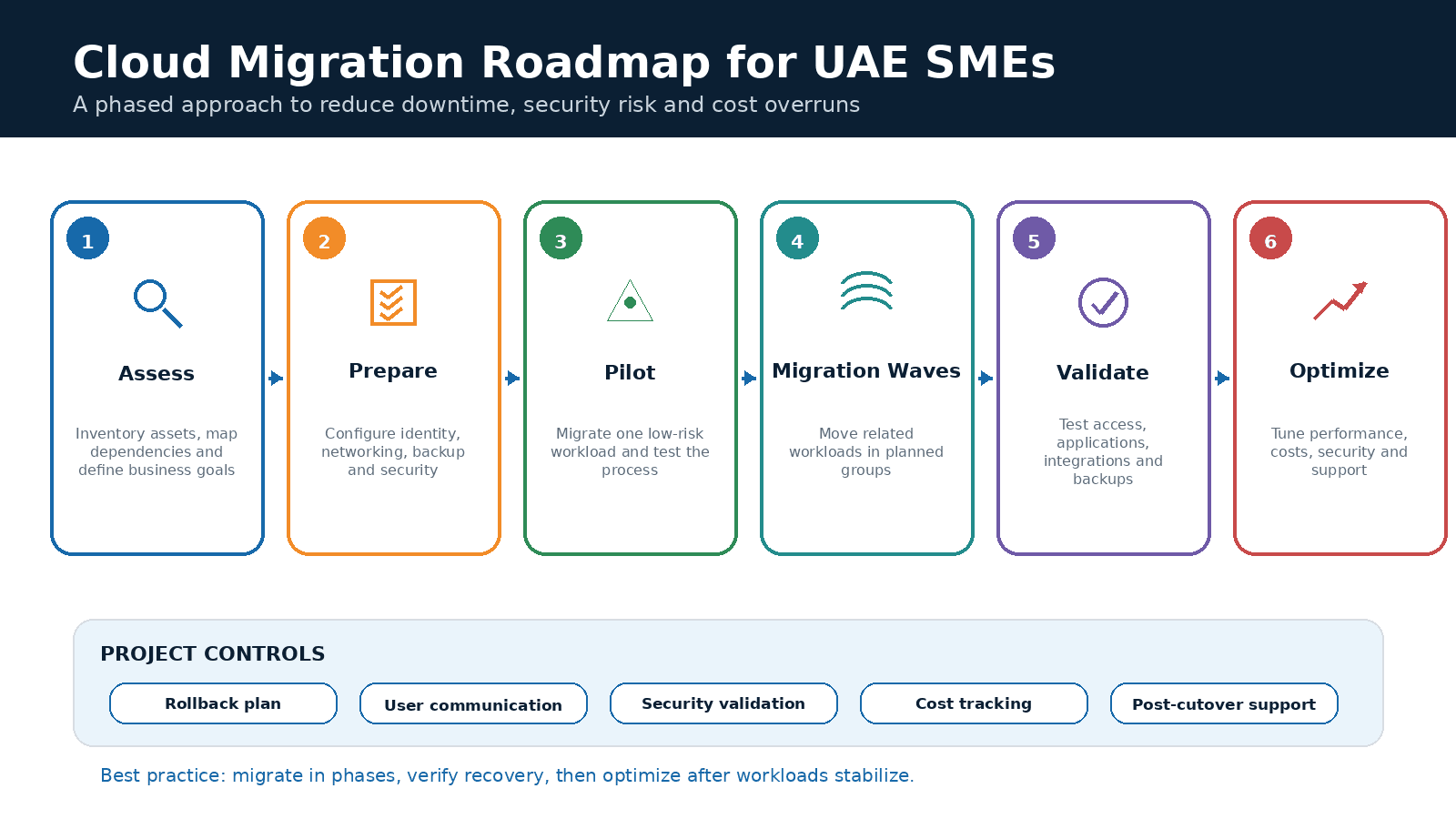
Cloud Migration Planning Snapshot
What Is Cloud Migration?
Cloud migration is the process of moving applications‚ data‚ files and workloads from an organization's on-premises computer infrastructure to the cloud‚ or from one cloud environment to another․
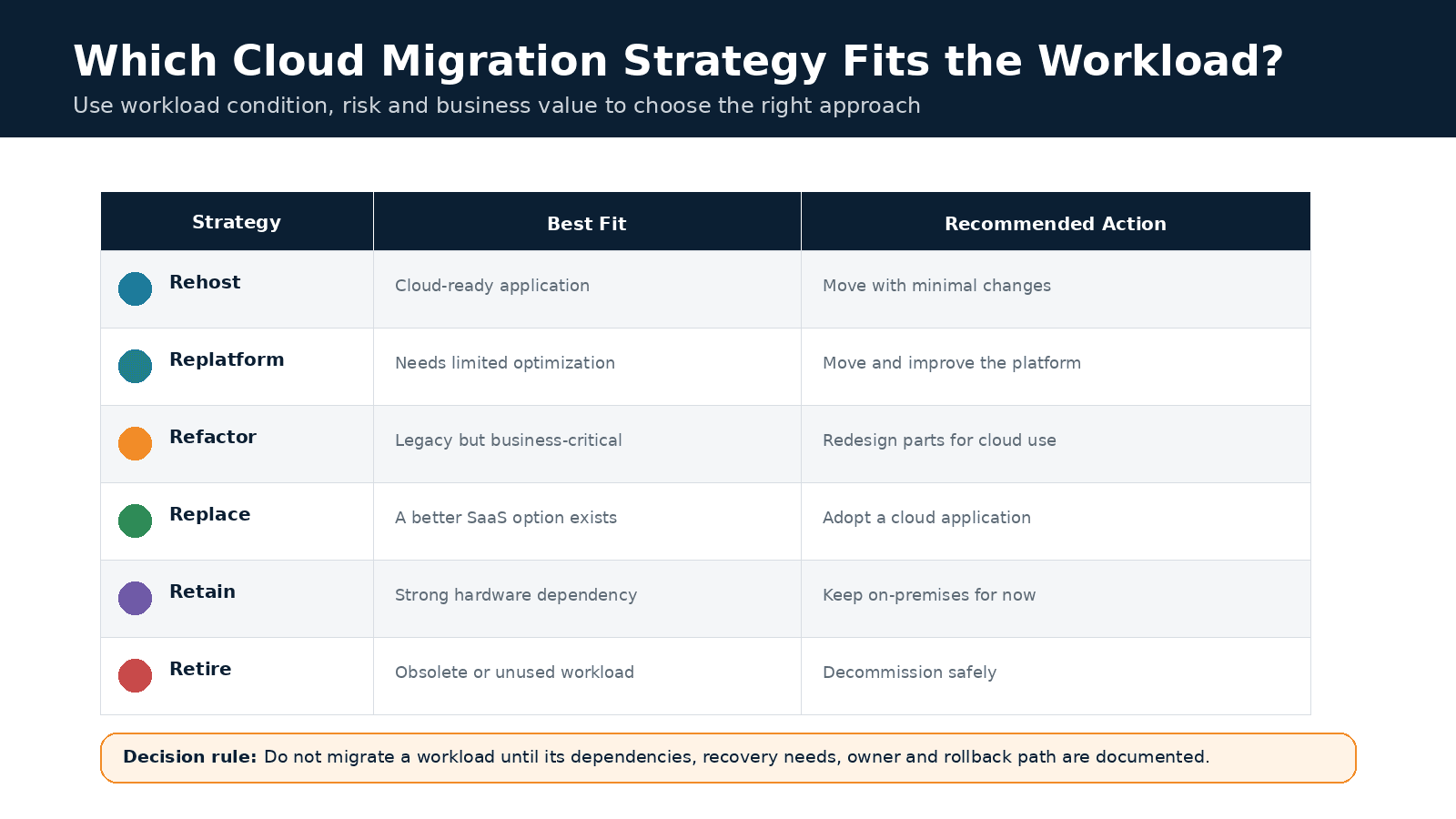
Not all workloads are moved to the cloud‚ however․ Some are rehosted (moved as-is)‚ some are modernized‚ some are replaced with Software as a Service (SaaS) applications‚ and others are not moved if they are better suited to run on-premises․
Which Workloads Should SMEs Move First?
The safest migrations are those delivering immediate business value with the least operational risk․ Early candidates include collaboration software‚ file storage services‚ cloud backups‚ development environments‚ and virtual machines with few dependencies․ Applications with hardware/platform dependencies‚ or pre-existing applications not supported on the cloud‚ are typically retained on-premises until migration of these assets has been planned․
Cloud Migration Timeline for SMEs
Every migration timeline depends on infrastructure complexity, application dependencies, data volume, user count, and acceptable downtime. Rather than attempting one large migration, SMEs generally benefit from phased implementation.
💡 Pro Tips
Select a pilot workload that is representative but not business-critical, then use it to test identity, networking, backup, monitoring, user access, rollback and support before migrating production systems.
Simple Microsoft 365 or file migrations may take only a few weeks, whereas application-heavy environments involving multiple offices or complex integrations may require several months.
What Drives Cloud Migration Costs?
One of the biggest misconceptions is that the cloud automatically reduces IT spending. In reality, cloud costs depend on architecture, licensing, governance, and operational discipline. Migration expenses fall into two categories: one-time project costs and recurring operational costs.
Cloud Migration Risks and Challenges
Other common risks include:
A Practical Cloud Migration Roadmap
Instead of migrating everything at once‚ SMEs can adopt a more systematic approach․ Create an inventory of servers‚ applications‚ users‚ integrations and business processes‚ classify by criticality and complexity‚ and design the target cloud architecture․
Establish security controls‚ networking‚ backup policies‚ and governance standards․ Perform a pilot migration of a non-critical representative workload‚ and then migrate production systems in planned migration waves․
Every migration must include validation‚ user acceptance testing‚ communications‚ rollback‚ and post-cutover support․ Optimize cloud resources after application workloads have stabilized․ Decommission infrastructure that is no longer required‚ then monitor it for performance and compliance․
SME Cloud Migration Readiness Scorecard
Before approving a migration project, organizations should evaluate their readiness.
Organizations scoring "Needs Improvement" across several categories should address these gaps before beginning migration.
UAE Security and Governance Considerations
Cloud migration projects must be guided by the organization's security requirements‚ legal obligations‚ contracts and industry standards to operate in the UAE․ Business should plan around identity management and encryption‚ backup‚ logging‚ access control and disaster recovery․ Further considerations are regarding data residency and the cloud region of the cloud service provider and the associated contracts and exit strategies․
How to Minimize Downtime
Minimizing down-time can best be accomplished using a phased or wave approach as opposed to a "big bang" approach․ Pilot projects allow teams to validate processes as well as ensuring that all relevant data has been synchronized‚ DNS changes planned‚ backups taken and the rollback process tested before proceeding with each wave․ Following the migration‚ there is a hypercare period‚ during which the system is monitored and closely supported until users adjust․
Common Cloud Migration Mistakes
Most SME cloud projects don't work because businesses migrate before understanding what their infrastructure is․ Common pitfalls include not documenting dependencies on workloads before migrating them‚ not testing backups of on-premises workloads‚ copying existing permission sets‚ underestimating bandwidth needs‚ and postponing cost optimization․ The migration itself should be treated as a continuing modernization program‚ not a one-time technical event․
Should You Use a Cloud Migration Partner?
Internal teams may also successfully manage simple migrations with skills in cloud architecture‚ networking‚ security‚ and project management․ Organizations with limited internal resources or a complex environment often need an experienced implementation partner․
Americana Computers consults with UAE SMEs to plan and implement their cloud migrations‚ including assessment‚ workload prioritization‚ security‚ data migration‚ backup‚ testing and post-migration support․
With infrastructure assessment‚ cloud architecture‚ cyber security‚ backup‚ disaster recovery and managed support‚ Americana provides businesses with thorough guidance‚ ensuring they migrate with minimum disruption to their productivity․
Conclusion
While cloud migration is mainly about lift and shift‚ it is also a modernization opportunity with business continuity‚ security‚ and operational efficiency as foundations of migration․ Phased cloud migration is generally less risky for most SMEs than attempting to migrate all of their systems in one go‚ allowing organizations to discover workloads‚ plan‚ build security‚ establish governance and optimize for cost to more easily adopt the cloud successfully․ Your organization is at its next major infrastructure upgrade and is looking for an independent cloud readiness assessment to determine the best migration strategy and the costs‚ timelines‚ and support model for the project․
Frequently Asked Questions
1. How long does cloud migration take for an SME?
Simple migrations may take weeks, while complex environments can require several months.
2. How much does cloud migration cost?
Costs vary depending on workloads, licensing, infrastructure complexity, and migration scope.
3. What are the biggest cloud migration risks?
Hidden dependencies, downtime, security misconfiguration, data loss, and poor governance.
4. Which workloads should migrate first?
Email, collaboration tools, backups, file storage, and cloud-ready applications.
5. What is the difference between reposting and replat forming?
Reposting moves workloads with minimal changes, while replat forming introduces limited optimizations.
6. How can SMEs reduce downtime during migration?
Use phased migration waves, pilots, tested backups, and rollback procedures.
7. Does moving to the cloud eliminate the need for backups?
No. Independent backups remain essential for business continuity and recovery.
8. How should UAE SMEs evaluate cloud security?
Assess identity management, encryption, logging, backup, access controls, and applicable regulatory requirements.
9. Should all workloads move at once?
No. Phased migration generally reduces risk and improves project control.
10. When should an SME hire a cloud migration partner?
When internal expertise is limited, dependencies are complex, or downtime carries significant business risk.

Tehreem Fazal is a creative strategist, content marketer, and freelance writer with over six years of experience crafting impactful stories for local and international brands. She specializes in content strategy, brand storytelling, and SEO-driven writing across industries like fashion, real estate, food, digital marketing, lifestyle, and automotive etc. Her words have shaped the voice of leading names including Master Group, LUMS, Metropolitan Properties UAE, and more. With a background in English Literature, Tehreem blends creativity with strategy to make every piece of content resonate and convert. When she's not writing, she's exploring new ideas, brands, and narratives that inspire.

VPN vs Zero Trust for UAE SMEs: Secure Access Guide
Compare VPN and Zero Trust for UAE SMEs. Learn when to retain VPN, adopt ZTNA, and strengthen remote access with identity and device controls.
Read More
Multi-Branch IT Support UAE: Operations Guide
Learn how UAE multi-branch businesses can standardize IT support, secure connectivity, monitor systems, define SLAs and scale operations.
Read More